We use cookies to make this site work. We'd also like to set optional cookies so we can understand how the site is used and improve it. We will not set optional cookies unless you accept them. You can change your choice at any time from the Cookie settings link in the footer.
Strictly necessary cookies
These cookies are required for the site to work. They store your cookie preferences and keep your session secure. They are exempt from consent under PECR Regulation 6(4) because they are essential to deliver the service you have requested.
Optional cookies
Optional cookies help us understand how the site is used and provide additional features such as analytics, accessibility tools and translation. We will only set them if you accept.
Croydon Vocational Training Scheme
About the Croydon Vocational Training Scheme (VTS)
Croydon GP VTS is in the vibrant and rapidly expanding London Borough of Croydon. There is an eclectic demography with a multi-cultural and diverse population. Within Croydon there is a vast choice of GP practices in areas ranging from leafy suburbia to inner city settings. VTS trainees are therefore exposed to patients with a wide variety of backgrounds, diseases and health needs, ensuring a comprehensive preparation for their future careers.
S1/2 posts, apart from Psychiatry (SLAM) and Palliative Care (St Christopher’s) are based in Croydon University Hospital. Most general practice-relevant specialities are offered and there is further choice in our 4 Innovative Training Posts in Rheumatology, Dermatology, and Paediatrics.
Croydon offers many opportunities for cultural, sporting and other leisure pursuits, which promote a healthy life-work balance. Being only 20 minutes train-ride away from Victoria, it has excellent transport links to London and beyond, as well as a Tramlink network.
During your GP training in Croydon you will be in a position to encounter a mixture of full time, secondary care posts and unique GP Plus roles.
What are GP Plus roles?
GP Plus roles are typically taken during a 6 month rotation block in General Practice which is split into half the week spent in primary care and the other half in a speciality which we offer. These posts have been well received by our trainees in particular the ability to gain experience in "deep end" general practice and an opportunity to see how the wider primary care community works. Here in Croydon we are proud to offer such a wide range of GP Plus roles for our trainees and have had excellent feedback for our placements so far.
Currently Croydon GP Training Scheme offers the following ITPs
- Dermatology
- Medical Education
- Rapid Response
- Prison Medicine
- GP collaborative
- Perinatal Mental Health
- Complex Care
- Palliative Care
What will a typical GP Plus week look like?
The 40 hour work week will be split with 4 sessions in General Practice (16 hours), 4 sessions in a GP Plus role (16 hours), 1 sessions for half day release for group teaching (4hours) and 1 session for directed self-study (4 hours).
Feedback from trainees
“Croydon is a fantastic place to train and practice. Having the chance to practice in both the rural and urban parts of Croydon has given me exposure to a wide range of demographics in the local population. The teaching sessions were always focused and related to GP life and were run weekly. Overall a great experience with a lot of support from peers and trainers!”.
“I really enjoyed the integrated training posts offered at Croydon. Learning specifically about dermatology over 6 months whilst in a GP post helped me to consolidate secondary care treatment measures in a day to day general practice surgery. This proved invaluable to my confidence in a common topic in GP life and I love the opportunity to attend extra-curricular dermatology conferences outside of working hours”.
"I have really enjoyed moving to Croydon for my training. It was an easy place to train whilst supporting my family. The team have been extremely accommodating and flexible with my less than full time training. I have felt my development as a clinician has been well supported and have found a great balance with my career and family. Really loved my placements and have found them all to be very useful for my day job!"
Being a GP in Croydon
Transport
Easily accessible transport links in and out of Croydon make this borough an easily commutable journey for our trainees if not already living in the area.
East Croydon station is only a 15 to 20-minute train journey away to central London stations such as London Bridge and London Victoria.
There are multiple bus routes and Tram lines that also run through Croydon itself making commuting in Croydon easy and flexible.
A GP's Life
Some of the things you need to know
If you’re looking for a VTS programme that can offer you clinical challenges, Croydon is the one to come to! It is the largest London Borough and is inhabited by a variety of different population groups. Thus it provides an exciting opportunity to manage a plethora of illnesses. You will regularly encounter diseases such as HIV, sickle cell, malaria and TB both in hospital and in the community.
In the north of the borough much of the population does not speak English as their first language and developing a variety of communication skills becomes a fundamental part of your training. Negotiating management plans with challenging patients, or encouraging health promotion through patient education is also key.
South of the borough is home to one of the richest parts of London – Purley. This polar opposite area gives trainees exposure to the demands of those that can afford private healthcare or ‘Google’ their illness online before coming to see you with a host of questions regarding treatments that do not exist on the NHS or statistics that will keep your math’s skills up to date!
Fear not though, all of the above is done under a wonderfully supportive umbrella provided by the Programme Directors (PDs) and Trainers. They will teach, guide and encourage you regardless of the hurdles you encounter and ensure you come out the other side smiling. Feedback is always welcome – whether positive (or negative) – ensuring this VTS programme continues to provide the educational and learning development vital for any GP VTS trainee.
Frequently asked questions
Congratulations on being successful with your application to the Croydon GP Training Scheme. We are confident you have made the right choice and that you will learn a lot during your time with us.
We understand that new trainees may experience some uncertainty when starting on this journey and we have compiled a list of FAQs that are among some of the most common questions we are asked by trainees.
We hope these are useful and if you have any additional queries we are happy to be approached. We look forward to getting to know you soon.
1. I would like to change/swap my clinical rotations that I have been allocated by the Health Education Team (HET). Is this possible?
We get numerous requests of this nature from trainees who feel they are duplicating previous experience with the hospital rotations that they have been allocated. Unfortunately, the allocations and the duration of the rotations are out of our control. Croydon is a popular scheme and we are usually operating at maximum capacity every year. This means we do not have any unallocated/spare rotations so trainees will normally have to accept the rotations that the HET have allocated and authorised.
2. I am worried that the rotations I have been allocated will not provide a range of experience – is there anything that can be done about this?
Current GP trainees will spend longer in primary care than trainees have ever done in the past. Nationally, the GP programme has seen a shift to increase the time trainees spend in primary care to 24 months out of the 36 months of training. The thinking is that the additional time in primary care is the most relevant experience a trainee could have on the route to becoming an independent GP.
Furthermore, during your GP placements you will have one session (half day) per week for self-directed learning. Trainees often use these sessions to gain experience in fields they feel they lack knowledge. Some examples of what recent trainees have done include sitting in on clinics for specialties, joint clinics with Psych trainees, going out with the community palliative teams etc.
You will have to arrange this yourself but your GP Trainers are very experienced and will, in all likelihood, be able to connect you with clinics/consultants. Failing that, the PDs can also provide advice on who you can approach to arrange these. This would allow you to use your self-directed learning time to address any learning needs you have identified.
3. Where can I access the GP Training induction information and guidance?
Induction booklets are updated annually and are available to download at: HEE GP Induction - please download a copy for your reference as it contains important information about your lead employer, health education team, annual/study/parental leave entitlement, ePortfolio, salary and much more. It also has a list of contacts that you may need for specific employment/training related queries.
4. Who do I contact about any employment related issues?
such as pre-employment checks, contracts, work schedule, leave entitlement, salary/payslips, expenses etc
The GP LEO (Lead Employer Organisation) should be your point of contact, NOT Croydon University Hospital. The GP LEO for Croydon is the Royal Free team. All contact details are shown in the GP Training induction booklets that are mentioned in Q3 above.
For quick reference, their telephone number is 0203 758 2059. You may be provided a username/password directly from the GP LEO to be able to access support via an e-portal instead.
5. I am planning on taking parental (or extended) leave early in my training. Who do I contact about this?
You would need to seek agreement from the GP LEO as well as the HET (Healthcare Education Team). All contact details are shown in the GP Training induction booklets that are mentioned in Q3 above. If you are approved to take extended or parental leave early in training, please also make the PDs aware (via email) so that we are not expecting you for teaching sessions and so that your Educational Supervisor can be informed.
6. How can I access Occupational Health (OH) services for any work-related adjustments I may need?
Again, this is something that is coordinated by GP LEO. You will need to discuss your request with your Educational Supervisor who will be able to refer you for an OH assessment via the Cohort Online Portal. You will then be contacted directly by the OH team to arrange an appointment. The OH report will remain confidential and PDs are not able to access this automatically. Therefore, if any adjustments are agreed then please share the OH assessment outcomes with the PDs so that we can alert your future clinical/educational supervisors as well as ensure that your training remains compliant.
7. How does study leave work and how much study budget can I claim?
Trainees may take a maximum of 30 days study leave a year (up to 2.5 days per month). This includes attendance at GP VTS teaching sessions and residential events - which means that between 15 and 17 of the 30 days are allocated for the VTS. Therefore, a minimum of 13 days of study leave a year are available to be allocated for other educational activities. Study leave is calculated pro-rata when trainees are working less than full time. Personal study time is capped at 5 days per year for examinations, however, this is in agreement with your supervisors and as such needs to be discussed with them.
Study leave opportunities can be categorized as mandatory, optional or aspirational. Mandatory training should be provided through the half day release or in the workplace. It does not usually incur additional cost and should not require additional study leave to be taken. Optional training must be approved by your Educational Supervisor and needs to demonstrate that it meets your individual curricular requirements. You should also have approval from the rota coordinator to confirm that patient care is not compromised in your absence. Aspirational training can be accessed in order to develop particular interests or curricular needs. This should be agreed in consultation with the PDs and Head of School. This flowchart summarises the process further: Study Leave Flowchart.
HEE have published lists which detail the mandatory/optional courses where funding is pre-agreed. These can all be found on the study leave homepage: Approved Courses List. The approval forms, receipts and evidence need to be submitted via GP LEO ‘LES E-Expenses’ system. Reimbursement can only be claimed once the course has been attended. Further information (including upper limit of claims) is available via the HEE support pages: HEE Study Leave Information.
8. How do I get access to the trainee ePortfolio on FourteenFish?
Register with the RCGP as an Associate in Training (AiT). This is an online process (with a fee) that provides access to your training portfolio - Register Now. This will automatically create you a FourteenFish account and you should receive an email with instructions. Please log in to FourteenFish with the same email address you used to register with the RCGP. This process can take a few weeks so please register as soon as possible.
9. I am thinking about going less than full-time (LTFT). Is this possible and what is the process?
Trainees can apply to work less than full-time – usually between 60% to 80% of full-time. The process can take 16 weeks to complete so it is important to be organised and to ensure that you follow the correct procedure to avoid delays. Your first step should be to discuss your situation with the PDs so that we can advise on possible options.
The eligibility criteria and step-by-step process is detailed in the following guide - LTFT Guidance (March 2022). Applications are made online to the Health Education Team (HET) via the PGDME Support Portal (LTFT Application Form). If your application is successful, then your duration of training will be extended to ensure it is equivalent to 36 months of training on a full-time basis.
10. Is it possible to shorten my GP training by having some of my previous training experience count?
I have switched training programmes from another speciality.
This may be possible under the Accreditation of Transferable Capabilities Framework (ATCF). Many core competences and capabilities are common across some, but not all, specialty curricula. When moving from one approved training programme to another, competences and capabilities gained should not have to be repeated if already achieved. Trainees who decide to change career path could transfer competences and capabilities achieved in one approved setting to their new training programme.
The time to be recognised within the ATCF will be reviewed at the trainee’s first Annual Review of Competence Progression (ARCP). Where accreditation is not granted, trainees will be expected to complete the full training programme.
Important:
Any acceptance onto a combined training programme is at the discretion of the HEE local office or deanery. To qualify for ATCF, you must have an eligible training/employment history and you will need to demonstrate that your experience is relevant to GP training by mapping your capabilities to the GP curriculum.
Applicants wishing to be considered for ATCF are expected to indicate this on their GP training application form. Further information about eligibility/application is available here: Combined Training Pathways.
11. How do I find out the details about the local induction process?
The hospital trust should contact you in advance of your start date to provide you with more information about the trust as well as the induction process. If you are starting on a GP placement then one of the PDs will send an email introducing you to your GP Trainer. The email will include details of the practice you are to be placed at. You should then contact the GP Trainer directly to enquire about induction processes and timetables.
12. Who are the GP practices attached to the Croydon GP training Scheme and what geographical areas do they cover?
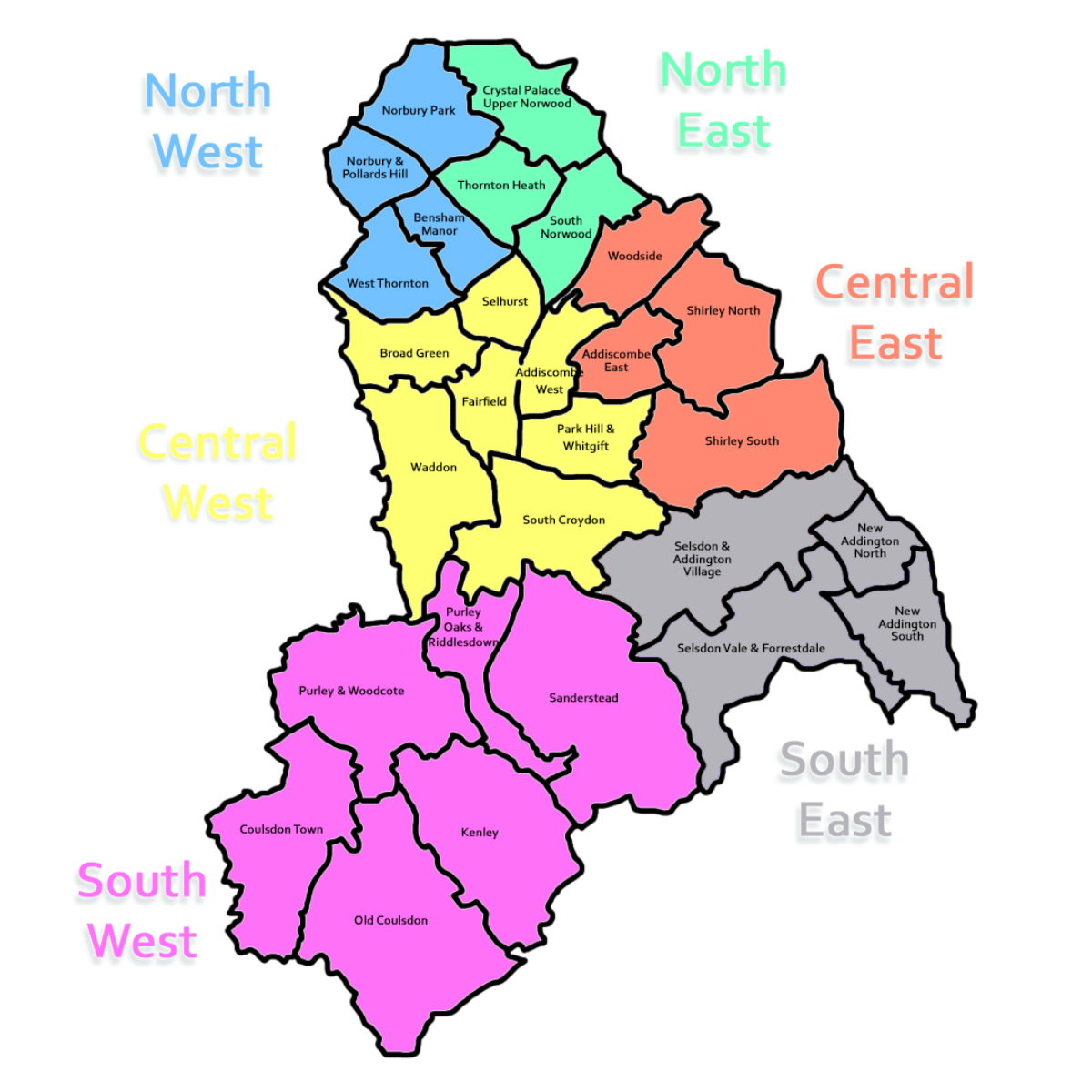
Training practices are based across the most of the Croydon boroughs and include areas such as Coulsdon, Purley, Selsdon, central Croydon, Norwood, Norbury, Shirley, New Addington and Thornton heath, to name a few.
13. Am I able to choose which GP practice I will be placed at?
Your GP placements will be auto-allocated during your VTS. It is impossible to provide a choice for every GP placement, as there are too many variables/factors that need to be considered when placing trainees. Training standard in all practices is monitored and maintained to a high level.